It is fundamental to certain societies to believe that there could be rescue in a dire situation. We all know that it doesn’t always happen in this life. But we want to believe that sometimes rescue does come at an unlikely moment. It is, in fact, more likely to be true in a society that teaches its children that such a thing is possible, and that it is considered heroic to try, even if the rescuer dies.
Diane Tucker’s latest blog post on The Shy Museumgoer is about this possibility, as brought to life in the legend of Saint George and the Dragon. She describes the birth of the legend, ties it back to Perseus and Andromeda, and shows us some beautiful paintings in the process.
I had fun looking for more art involving Saint George. Here’s some from the National Gallery of Art in Washington, D.C. This gilded alabaster sculpture from 14th century England has lost a few parts but it is still quite enchanting. Pay attention to the direction the horse is facing. (…towards the dragon…)
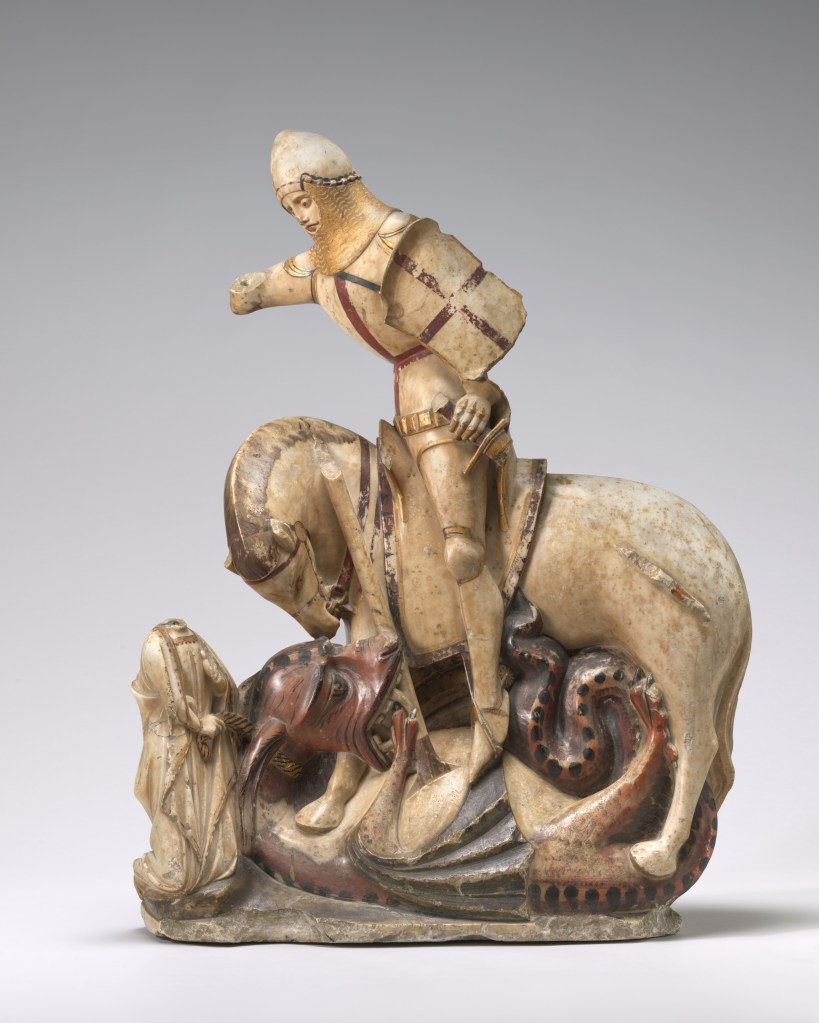
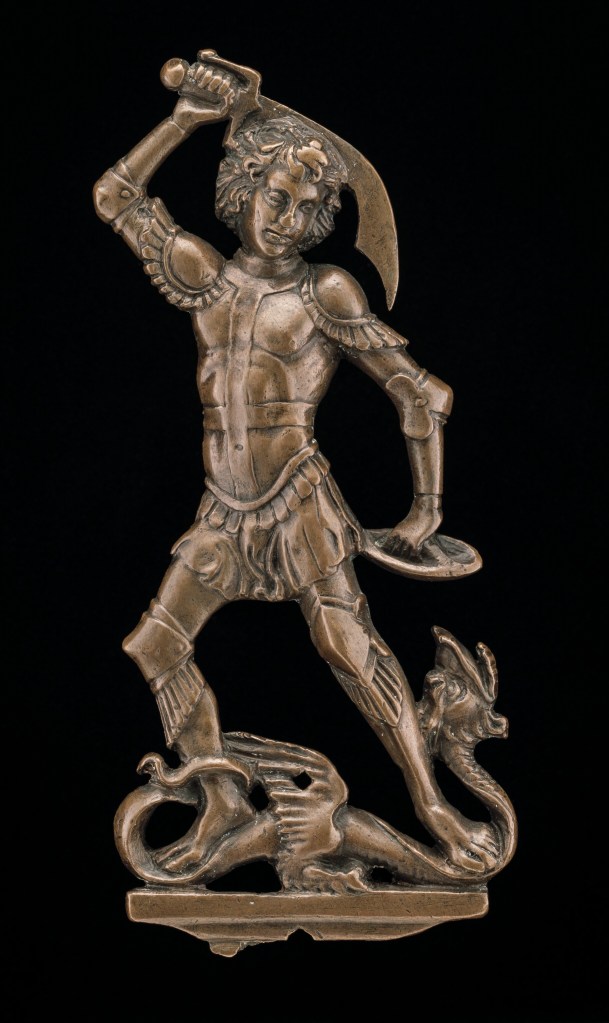
Saint George and the Dragon
15th century bronze.
North Italian.
No horse, no princess.
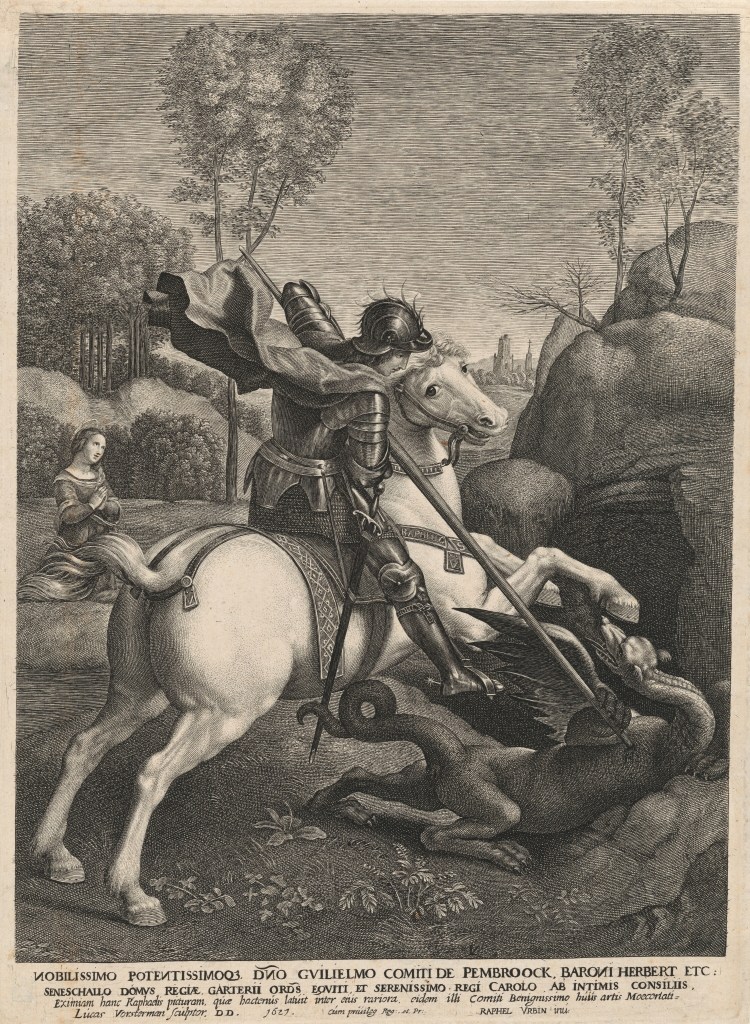
I love this 1627 painting by Flemish artist Lucas Emil Vorsterman. Saint George and the Dragon, ‘after Rafael’. Diane Tucker compares two paintings of Saint George, both done by Rafael. The second one was done after Rafael had met Leonardo da Vinci. It is fascinating. And this engraving is definitely paying homage to Rafael’s second painting! Check out that horse’s eye.
This last example of Saint George and the Dragon art (there are boatloads at the NGA) is by Giovanni Antonio Bazzi, also known as Sodoma. He was a Sienese painter, 1477 – 1549. Check out the horse again. Also, this time the lady is looking at Saint George. Many of the other images show her praying or looking at the dragon and facing the same direction as Saint George. So her pose here is a bit different. Also, all the dead bodies in the foreground are a bit gruesome if what you should expect around a dragon.
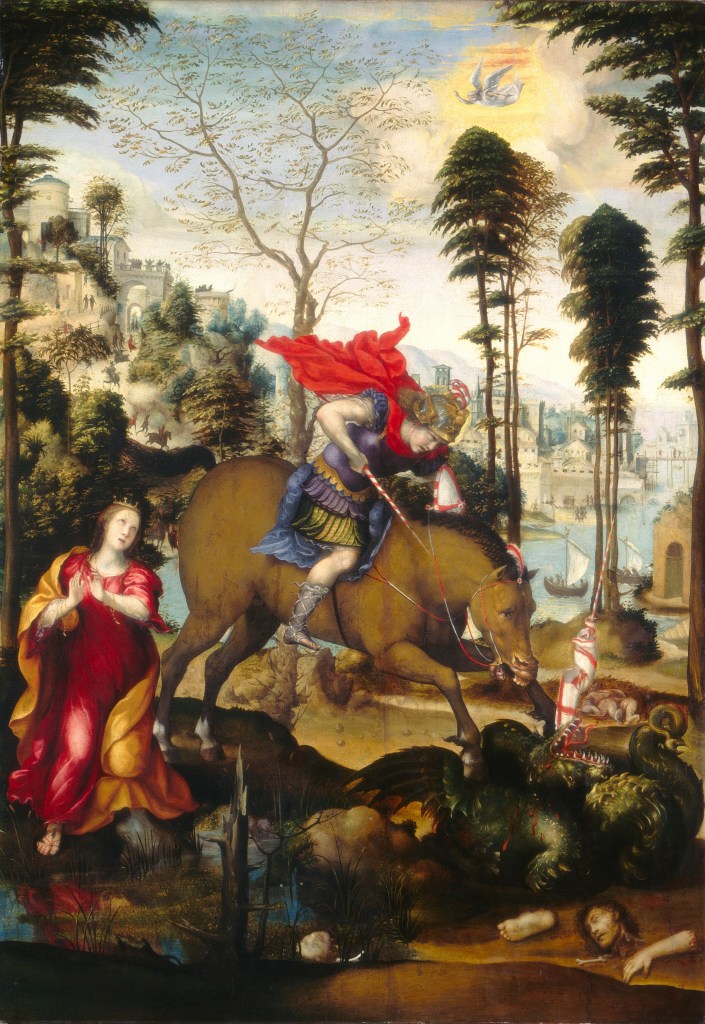
There are lots of people and lots of activity in the background of this picture: people on parapets, in boats, riding up and down the road. I can’t tell if any of their activity is related to Saint George. Hmm.
Note ONE: Many years ago, a high school student that I was acquainted with wanted to try teaching. He joined the Future Teachers of America and was sent out to read stories to fifth graders. I don’t know the name of the story he was given to read but it was something quite dreadful. He said that he realized that the story was going to have a terrible ending, that there was no rescue coming for whatever situation had been set-up, and he couldn’t bear to read it straight. So he invented a better ending that day, and quit the FTA. This article is for him.
Note TWO: At the end of her article, Diane Tucker discusses dragon-inspired architecture in Barcelona by Antoni Gaudi (not from the Familia Sagrada). It’s quite charming. She also provided this link to another of his architectural wonders. This is a video that plays immediately. https://parkguell.barcelona/visitavirtual/?lang=eng
The header is Rogier van der Wyden’s take on Saint George and the dragon. NGA

