Today is the Feast of Saint John of Capistrano. He is famous for helping John Hunyadi break the Siege of Belgrade in 1456. And then dying of the plague spread in the aftermath. This lovely altarpiece from the Walters Art Museum, titled Saint Louis of Toulouse, Saint Francis, and the Blessed John Capistrano, was constructed within fifty years. (John is on the right.)
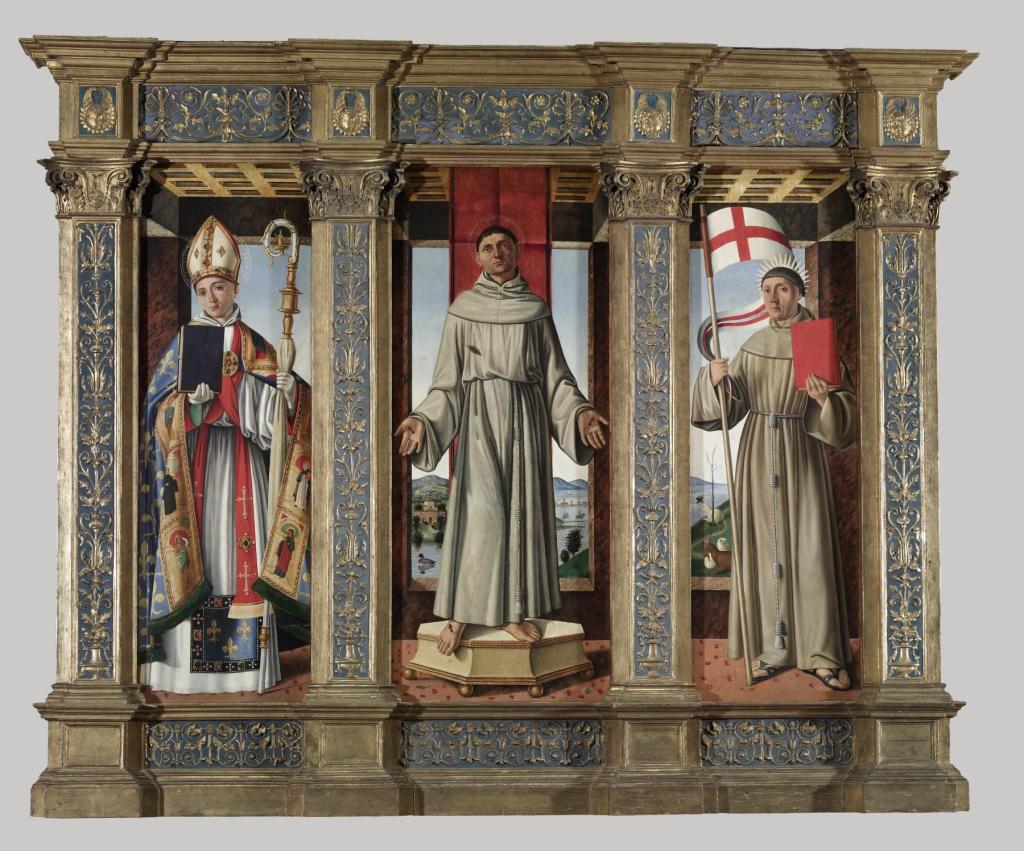
The artist who did this altar, Cristoforo Caselli, was born around 1460 and died in 1521. Hence the title of this work, Blessed, not Saint. John was proclaimed a saint in 1690, though the Papal Bull wasn’t promulgated until 1724 under a different pope. Also, just to keep things clear, Saint Louis of Toulouse, the figure on the left, is a great nephew of King Saint Louis IX and was one of the children of the King of Naples. In the general warring of the times this meant he spent some time locked up. Eventually he renounced any claim to the crown of Naples, became a Franciscan monk, and the Bishop of Toulouse. He is said to have been a model bishop but he also didn’t last long, dying at the age of 23. He was born on February 9, an important date for other reasons.
Returning to the saint of the day… Before Saint John helped liberate Belgrade he was a famous Franciscan preacher, drawing crowds from all over, numbering in the tens of thousands. He helped reform the Franciscan order in the 1400’s, along with Saint Bernardine and Saint Colette, who was working on reform of the Poor Clares. All organizations, religious or not, will need reform from time to time, and the Franciscans were no exception.
Many miracles are told about Saint John and this lovely bit of art shows a number of them. He raised people from the dead and floated across rivers on his cloak spread on the water.
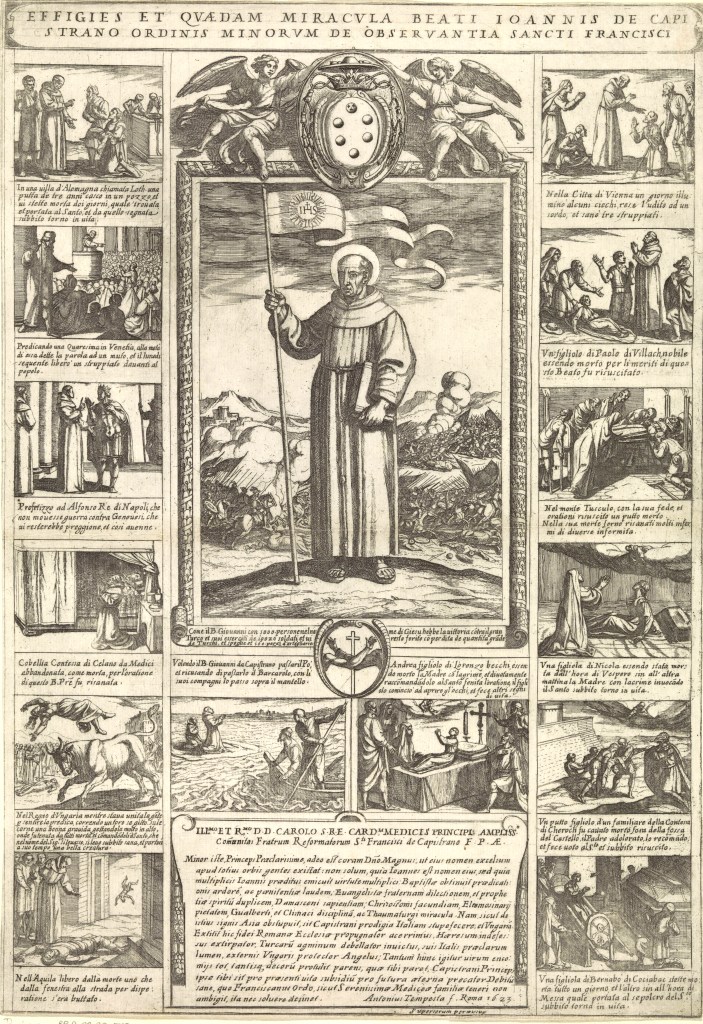
By Antonio Tempesta – www.rijksmuseum.nl, CC0, https://commons.wikimedia.org/w/index.php?curid=53842090
~+~+~+~+~
So … When I was a little girl we had a book about the swallows of Capistrano returning to the mission of San Juan Capistrano, in Orange County, California. I had no idea what was really going on in the book, except that everyone had a festival when the swallows returned.
Some of my confusion probably stemmed from the fact that the swallows appear in Capistrano around March 19 which is the Feast of Saint Joseph. They leave around October 23 which is Saint John of Capistrano’s Feast day. I suspect that my childhood mind thought the swallows should be called after Saint Joseph — and the mission as well. Never mind.
The swallows really do migrate right around these dates, spending the winter in Goya, Argentina. However, a renovation of the mission in the 1990’s, which knocked down a lot of their old nests, sent the swallows elsewhere when they came north. I think that’s a little sad after two hundred years of celebration though efforts are being made to lure them back to the mission church.

