The First Reading at Mass today is from the Acts of the Apostles, Acts 16: 22-34. Paul on his missionary journeys was arrested, beaten, and jailed in Philippi. He and his companions were in Philippi, a city in Macedonia, because Paul received a vision begging him to come and preach the gospel in Macedonia. He had great success until he chased a demon out of a slave. Her owners were making money from the demon-possessed woman so naturally they were angry that this was no longer possible. Also, naturally, that is not the reason they gave for dragging Paul before the authorities. Instead, they claimed that Paul was advocating practices unlawful for a Roman citizen.
Hence, and this is where the reading begins, the magistrates arrested Paul and Silas and put them in prison. The jailer was told to keep them secure, so he put them in an inner chamber and chained their feet to a pole.
There are three moments in the Acts of the Apostles where a prison is broken open. Peter and John are arrested early on. When angels break them out, by quietly opening the doors, everyone is amazed, and the authorities let them go — after flogging them.
At a later moment, Peter is arrested and an angel takes him out of prison quietly, walking past the guards and through the doors so silently that Peter thinks he is dreaming, until he finds himself alone in a alley. Here’s an engraving of that event…by Philip Galle, a Netherlandish painter from the 1500’s (NGA, public domain)
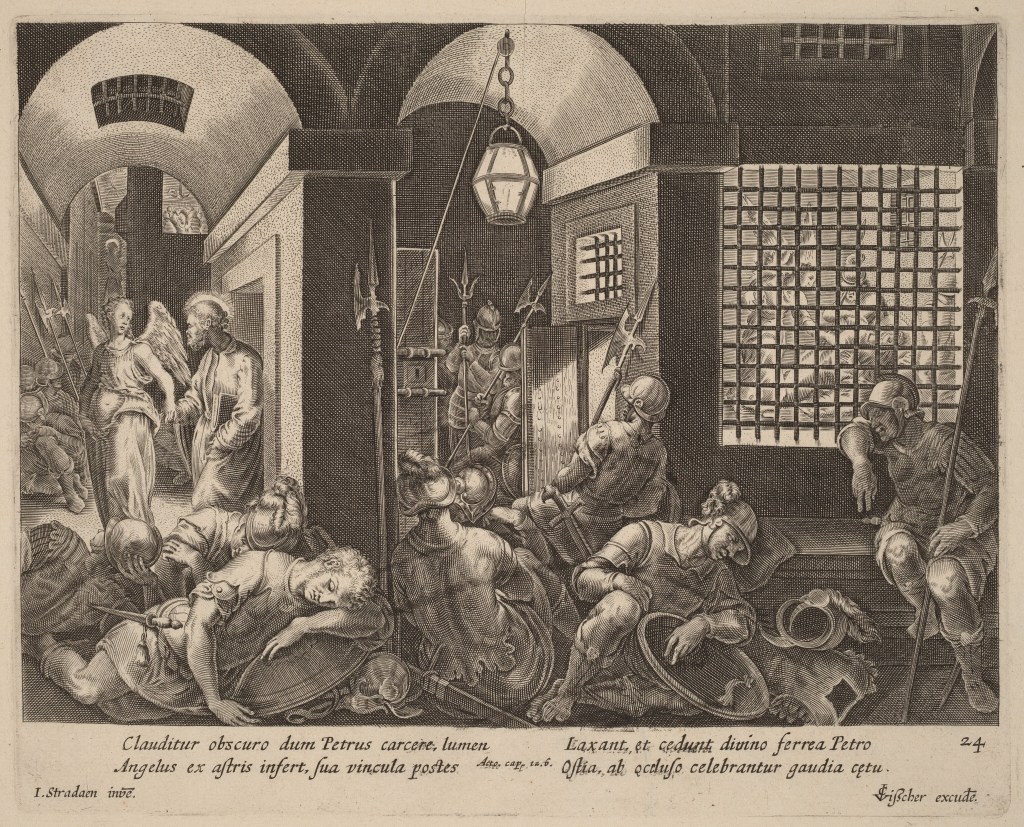
The repercussions of this escape are savage for the guards, who are executed, even though it’s obvious they couldn’t help it. At least, if they are dead they won’t be able to talk about what happened.
Back to the reading for today… At midnight while Paul and Silas were singing and praying, an earthquake shook the prison, blew the doors open, and broke all the chains holding prisoners. This is where things got really interesting. The jailer seeing the open doors was going to kill himself, assuming his important prisoners were lost. Paul calls out to him not to do this because he and Silas had not escaped.
When the third angelic breakout occurs it is Noisy. And in the general context we can see why the jailer is going to kill himself. He believes the authorities are going to execute him for failure in his duties and they probably won’t be nice about it. Surely this is why Paul and Silas do not take advantage of their road to freedom. They know what happened the last time. Instead of leaving they bring salvation to the jailer and his family, because when the jailer realizes that his prisoners could have left but didn’t, he falls on his knees and asks what he must do to be saved. He and his whole household are baptized.
I love this picture of Saint Paul, except for the eyes, which look a little crazy. But the sense of confinement around him, with worlds in the background seems appropriate for someone who traveled all over but also got arrested a lot.
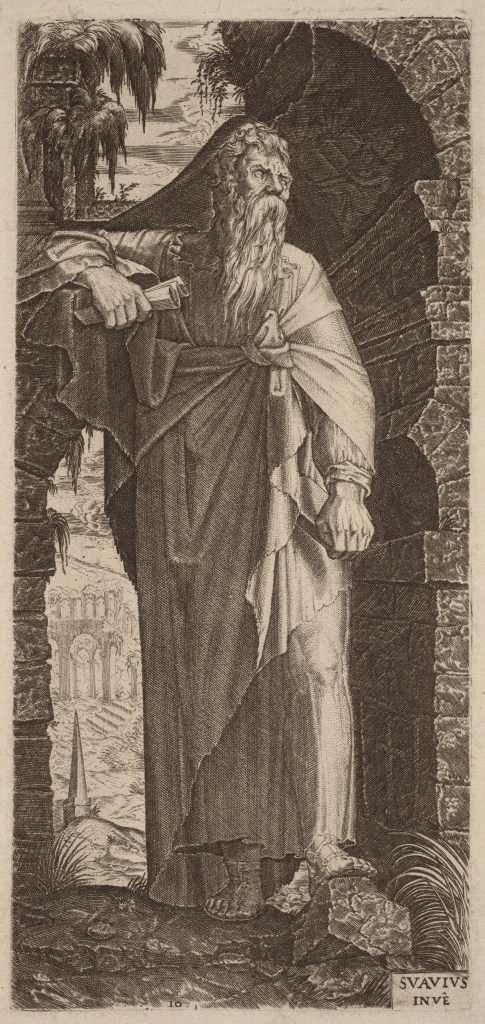
Saint Paul, c. 1545.
Lambert Suavius
Flemish.
 Janey's blog