Augustin-Jean Fresnel (1788 — 1827)was a Catholic scientist in France in the early 1800’s. He made incredible contributions to the understanding of light, being one of the earliest and best champions of the idea that light is a waveform. He entered the French school for engineers around 1804 and then served in the engineering corps for years, somehow getting caught up in Napoleonic politics in the process. He was sent to work on lighthouses in 1819 and died eight years later. Eight years is not a lot of time to invent and bring into production any important piece of equipment but Fresnel did it, inventing the Fresnel lens, a tremendous upgrade to the equipment in lighthouses. His lens increased the amount of light that could be seen without demanding more torches or extra fuel. In fact, he saved lives. He was thirty-nine years old when he died. These days I think that’s very young. He was very devout, not to say Jansenist.
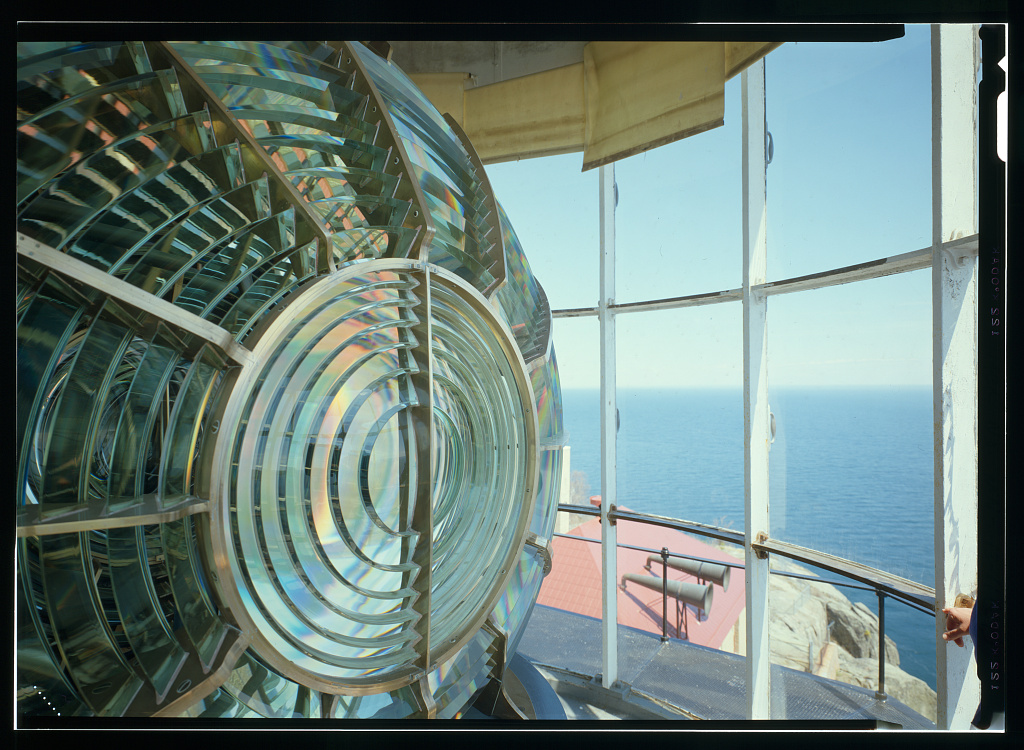
Historic American Engineering Record, Creator. Split Rock Lighthouse, Off Highway 61, 38 miles northeast of Duluth, Two Harbors, Lake County, MN. Documentation Compiled After. Photograph. Retrieved from the Library of Congress, <www.loc.gov/item/mn0184/>.
I know about Fresnel lens but have never played with one. Today they can be made of various kinds of acrylic, and molded, rather than being made of cut glass. They will set fire to a piece of wood faster than a regular magnifying glass will, and as such seem like a great idea for backyard pyromaniacs. I was idly dreaming about Fresnel’s lens and wondering about getting one for playing with my grandchildren when I ran across an article that suggested that Fresnel was getting too much credit for them. No link because it was a snarky article but I went looking elsewhere and found a discussion in the files of the Unites States Light House Society papers.
The URL takes you to a very brief comment on the question, and at the bottom of the page is a link which I Cannot Imbed no matter how hard I try. That link takes you to a deep dive into the question of who invented this wonderful piece of lighthouse equipment.
https://uslhs.org/resources/keepers-log/select-articles/who-invented-fresnel-lens
If you think ~TL:DR~ let me help. The article concludes that Yes, Fresnel invented his lens, and had it built and put into production in lighthouses. He was unaware of the work of several others in the 1700’s, such as the Comte de Buffon, who proposed a similar lens cut en echelon, but for the purposes of generating more heat. (You can see what en echelon means here by looking at the picture of the lighthouse lens from Duluth, up above.) Fresnel’s primacy was challenged shortly after his death by a Scottish scientist named Sir William Brewster. Brewster claimed that he had invented the lens before Fresnel did. Fresnel’s champions in this discussion were from the Stevenson family, who were famous builders of Scottish lighthouses. (Yes, Robert Louis Stevenson was the son of one of these builders and didn’t go into the family business because his health was too precarious.) They spent years defending Fresnel.
The story of Fresnel’s accomplishments with respect to light, itself, is well-told (by which I mean, very readable and enticing) in the MacTutor Biographies section of the University of Saint Andrews website. https://mathshistory.st-andrews.ac.uk/Biographies/Fresnel/ The most fascinating part of it to me (since I don’t understand the mathematics involved) is that when Fresnel applied for a prize for the best paper on diffraction he wasn’t believed. The committee included Poisson, famous in his own right for advances in mathematics and physics. Poisson said more or less, if this is true then I will see —that— if I do an experiment. He did the experiment and saw —that—. And Fresnel was awarded the prize.
Rabbit Hole: I read The Story of Rolf and the Viking Bow by Allen French many years ago and don’t remember much about it. But I do remember that in the book some characters built bonfires as proto-lighthouses, warning ships off of a dangerous headland. And I remember that the nearby village hated this since it meant that they didn’t have as many wrecks to scavenge. It was a great surprise to realize that lighthouses were controversial; people were happy to make a living off the death of others and resented attempts to prevent those deaths
Header: Minot’s Ledge light house with comparative sections of other Sea Rock light houses. Photograph. Retrieved from the Library of Congress, <www.loc.gov/item/2005688362/>. Copyright free.
 Janey's blog