My fundamental belief in looking at the physical world is this.
The world is more fascinating and full of wonder, than any one person will ever be able to understand.
I know some people see science and religion as being at odds with each other. This is something I cannot really comprehend on an emotional level, though I know plenty of people think it. My problem stems from my idea that God created the universe. If you study the universe to find out who He is, you had better get it right. It’s an insult to the Almighty to look for less than the truth.
While I wait for the proof copy of my novel, (whose blurb is not going to be the one I tried out last Friday), I wandered through a list of Catholic scientists, people who should be telling the truth about the universe, on the website of the Society of Catholic Scientists. Their list includes fascinating people I’ve never heard of, and leaves out people that I would have thought belonged. In the latter category Vincent Dethier (To Know a Fly) and John A. O’Keefe, III are good examples.
The first category, fascinating people I never heard of, includes Stephanie L. Kwolek (1923-2014), a chemist at the Dupont Institute in Delaware, who invented Kevlar.* That’s a little misleading in that she discovered a whole class of polymers that share the properties of Kevlar. They are incredibly strong and stiff and do not break down at low temperatures. Thus they can be used as fiber in applications like fire fighting gear. The story of Kwolek’s discovery of this new class of polymers is well told on the website.
Dupont was in the business of spinning fiber out of various chemical solutions to create, for example, nylon. Kwolek was researching new polymers (fiber is a polymer, a long chain molecule) and discovered a concoction that was liquid crystal, in that the molecules lined up in an orderly way, even in the solution. The Dupont spinners didn’t want to put her solution through their spinning machines at first, afraid it would ruin their equipment. But when they finally did try to spin, they got strong stiff fibers that lasted well at very high and very low temperatures. Kevlar is one variant. https://www.sciencehistory.org/education/scientific-biographies/stephanie-l-kwolek/
This story is reminiscent of the story of Father Julius Nieuwland, who discovered artificial latex/rubber, another polymer. Father Nieuwland was doing random chemical experiments. He accidentally created a solution with a surprising smell, and then spent many years trying to recreate it. When he finally did, it turned out to have the qualities of latex rubber. Places like Dupont, once they understood the general direction of the research created their own artificial rubber formulas and patented them. This was quite important right before World War II, because early in the conflict, the Japanese took over the rubber plantations in Burma and cut off access to the west. No rubber, no airplane tires.
Father Nieuwland, who started as a biologist but taught chemistry at Notre Dame University, was famous for carrying a gun around the campus. If he wanted a leaf specimen that was out of his reach, he would shoot it off its parent tree. https://www3.nd.edu/~wcawley/corson/nieuwland.htm
Stephanie Kwolek was inducted into the National Inventors Hall of Fame in 1995 and Father Nieuwland in 1996. https://www.invent.org/
*https://catholicscientists.org/scientists-of-the-past/stephanie-l-kwolek/
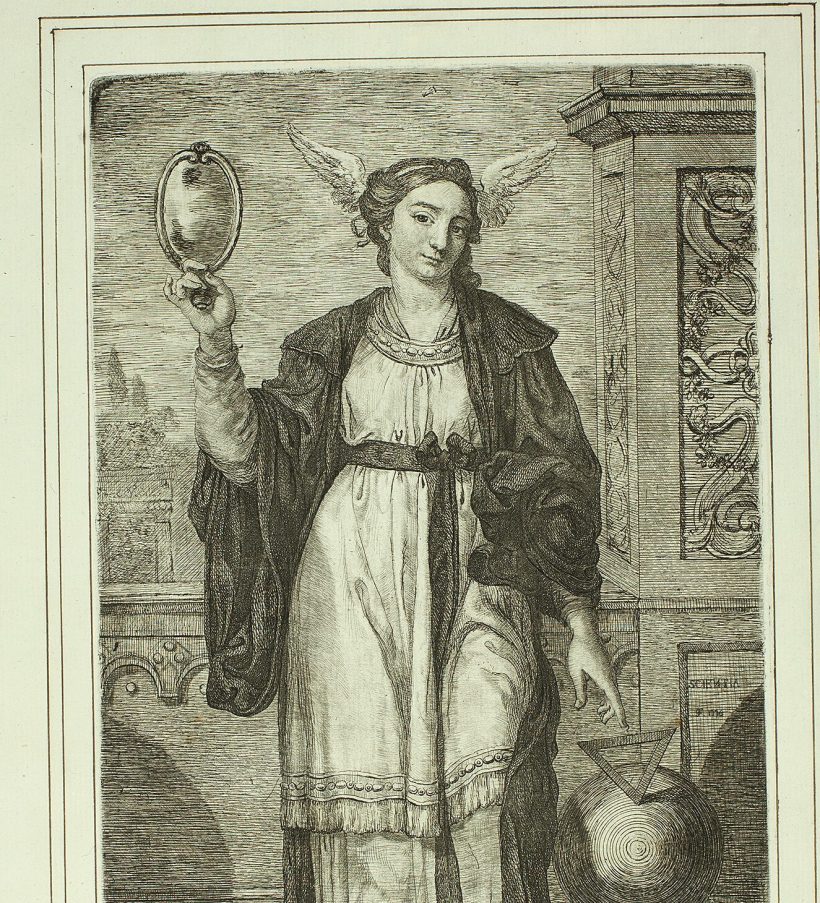
Female Personification of Science. Joseph Fratrel. The Art Institute of Chicago, public domain.
 Janey's blog