The Society of Catholic Scientists has a “set of curated biographies” of Catholic scientists on their website. https://catholicscientists.org/ I don’t know the basis for their choices. Their list isn’t exhaustive, of course. They have about 300 people on it. When I was working on a list twenty years ago I had 180 names that I discussed and I knew of hundreds more. The Galileo Project at Rice University which I could access in 1999 had at least 350 names of Catholic scientists just between 1500 and 1700. Richard Westfall, who composed that list, included every person he found who contributed to our knowledge of the physical world, even if such a person did not make it his career. I’m thinking of Charles Perrault’s brother, who discussed rainfall and recharge of the water table in a highly systematic way. Beginning and end of his science career!
In any event, I always struggled to find more modern Catholic scientists so I like to wander through the SCS list from time to time. Bertram Brockhouse who won the Nobel prize for Physics in 1994 was quite new to me. He “developed techniques for neutron scattering” among other things. https://catholicscientists.org/scientists-of-the-past/bertram-n-brockhouse/
Brockhouse was a convert to Catholicism, and one of his children went on to become a (Catholic) biologist. Charles Brockhouse wrote an essay about Catholic science which is available through Creighton university** (the link is at the bottom of the biography for Bertram Brockhouse) and contained comments about yet another Catholic scientist whom I inexcusably missed. (Inexcusably, because he is in the Catholic Encyclopedia!)
Jean-Baptist Carnoy was a priest and biologist in the 1800’s. He studied the cell in the microscope, inventing various fixatives for assisting in such endeavors. An article in the Catholic Encyclopedia discusses his work on cellular structure (cytology) at the University of Louvain. https://www.newadvent.org/cathen/03370b.htm Carnoy traveled widely after his ordination, studying at Bonn, Vienna, and Rome among other places. He then had priestly duties to carry out for sometime. Eventually he was called back to Louvain in Belgium where he taught courses in biology and cell structure. Charles Brockhouse makes it clear that one hundred and twenty years later biologists are still indebted to Carnoy.
During his travels, Carnoy met Francesco Castracane, another ‘naturalist’ and priest in the field of biology, while he was in Rome. Castracane (1817-1899) was an expert on diatoms, and was a pioneer in the use of cameras through the microscope. Diatoms are microscopic organisms whose shells are made from silica rather than calcium carbonate. Diatomaceous earth which can be bought at any gardening center is basically a bunch of diatoms. The silica is devastating to the slugs that would like to infest juicy tomato plants. It’s like crawling over broken glass for them. Castracane used his studies of diatoms to comment on problems in geology (there are lots of fossil diatoms) and ‘hydrography’. There are myriad varieties of diatoms and he used their distribution to comment on ocean currents. https://www.newadvent.org/cathen/03414c.htm
This lovely picture of diatoms comes from a website showing how to study diatoms. https://www.mccrone.com/mm/the-collecting-cleaning-and-mounting-of-diatoms/
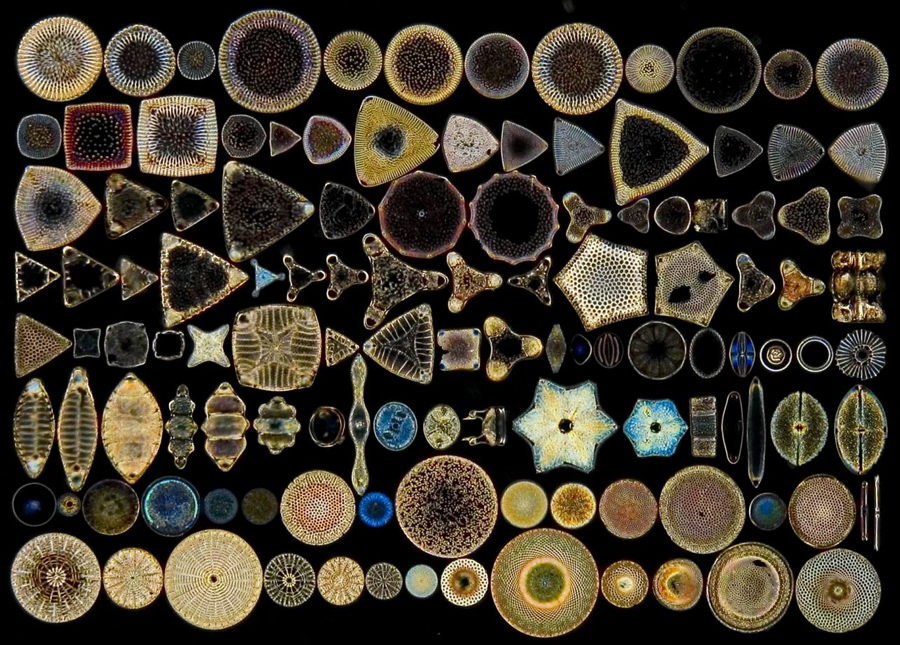
More pictures of diatoms can be found here. https://moticmicroscopes.com/blogs/articles/diatoms-nature-s-jewels-viewed-with-a-microscope?
Carnoy is still remembered because biologists use a solution that he invented. But that’s most of what he’s remembered for. I doubt if Castracane is remembered at all. Knowledge of the physical world is advanced one tiny but important step at a time by such people. I like to give them credit from time to time.
**A link to Charles Brockhouse’s essay, The Catholic Intellectual Tradition. https://cdr.creighton.edu/server/api/core/bitstreams/8d8207f9-2d77-4c10-b7b4-65f6a234cbaa/content
Header from the National Gallery of Art
 Janey's blog