The story of Saint Wolfgang, whose feast day coincides with All Hallows’ Eve, is equal parts inspiration and dismay for me. He lived eleven hundred years ago and was part of a great flourishing of holiness in the portion of Germany/Austria where he was active. That’s very inspiring. He’s part of a trio of saints from the time, about whom I knew nothing at all before looking up saints for October 31. That’s dismaying.
Saint Wolfgang (934 – 994) was an educator, Benedictine monk, confidant of emperors, protector of the poor, builder of monasteries, missionary, and bishop. New Advent says,
St. Wolfgang was one of the three brilliant stars of the tenth century, St. Ulrich, St. Conrad, and St. Wolfgang, which illuminated the early medieval period of Germany with the undying splendour of their acts and services. https://www.newadvent.org/cathen/15682b.htm
The article about Saint Wolfgang, which starts out with some very stilted language, ends up being full of information. It also comments on art created around this saint, so I went looking and found a glorious altarpiece from the 1400’s. Commissioned by a man named Christopher, it shows Saint Peter on the left in the tryptich, Saint Wolfgang in the middle, and Saint Christopher on the right. The portrayal of Saint Christopher is lively and somewhat untraditional. The four outer panels depict Our Blessed Mother, Mary, at various moments in her life. Saint George and Saint Florian are on the walls, and Saint Helena is at the top of the entire altar. Click on the link below to go to a larger image. You can mouse over that picture and get more information.
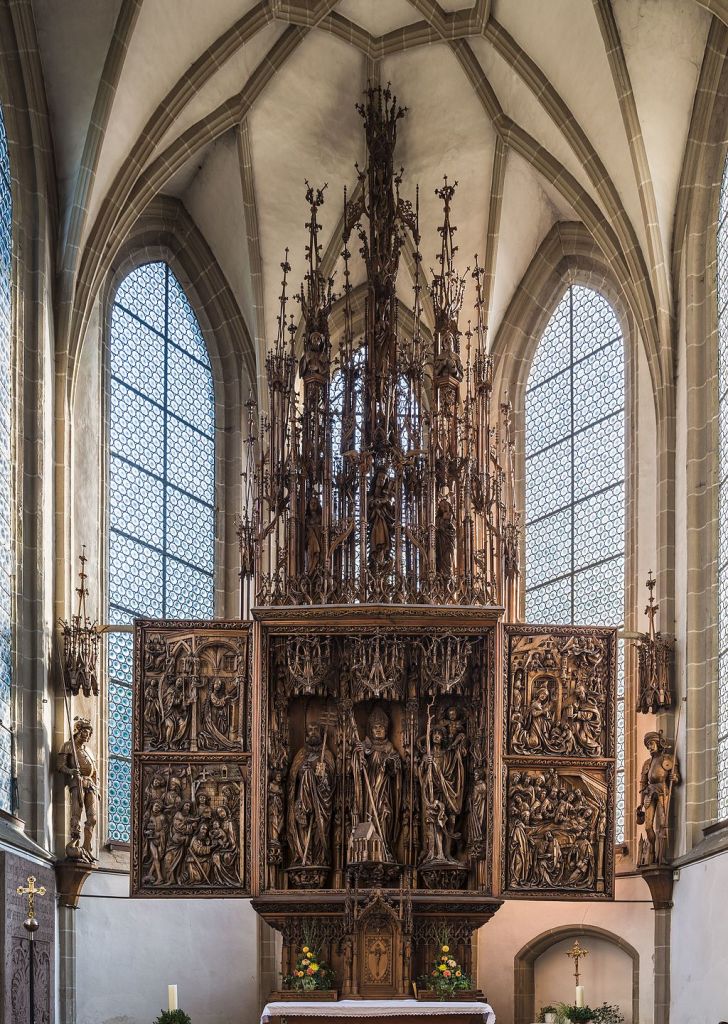
https://commons.wikimedia.org/wiki/File:Kefermarkt_Kirche_Flügelaltar_02.jpg#file Wikimedia commons. I believe the terms of use here are to link to the original file which I have tried to do. The altarpiece is extraordinary but so is the image that someone created.
More information. Saint Ulrich is notable for efforts to reform the clergy around him, and for being “one of the most important props of the Ottonian policy,” a comment which I find utterly unhelpful. He encouraged the defenders of the city of Augsberg, when the Magyars were pillaging their way across Germany, assisting them to hold on until Emperor Otto arrived and won the Battle of Lechfeld.
Saint Wolfgang was sent as a missionary to these Magyars after they were settled in Pannonia (the location of which escapes me entirely). He also buried Saint Ulrich who had foreseen the day of his own death, went outside and laid himself down on a cross of ashes, and passed on.
The Saint Conrad involved in this trio eludes me entirely. There are a whole bunch of Saint Conrads hanging out with the Franciscans on New Advent, but that’s not helpful, being hundreds of years too late. I’ll just mention that Saint Wolfgang is associated with several other saints as well, including the Holy Roman Emperor Saint Henry II. New Advent is notably cool in its description of this particular saint. https://www.newadvent.org/cathen/07227a.htm
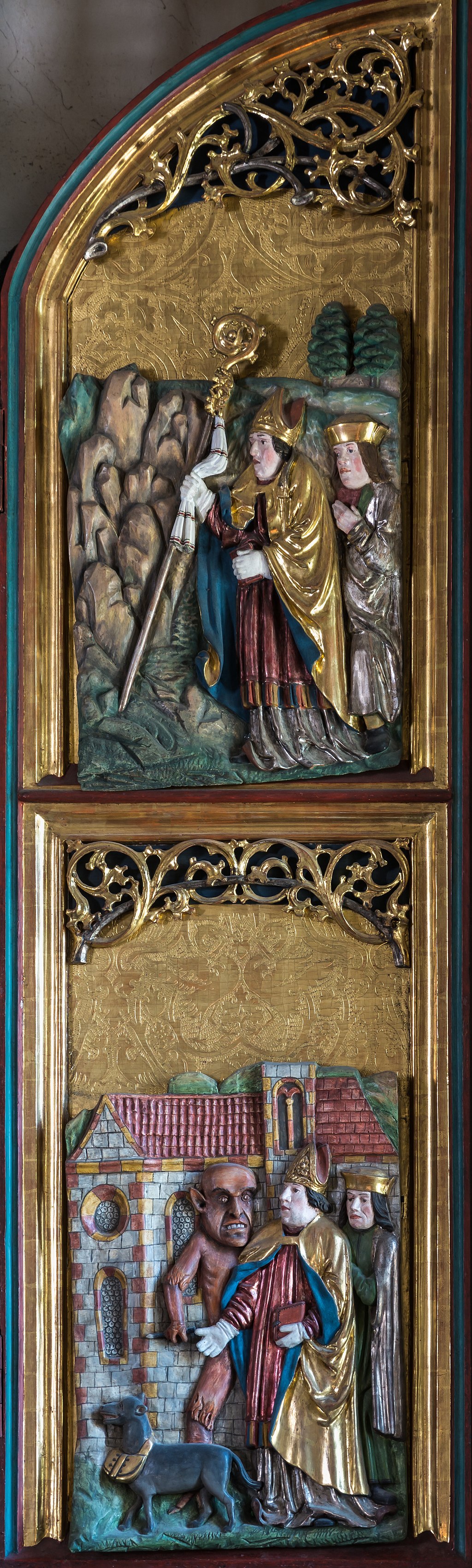
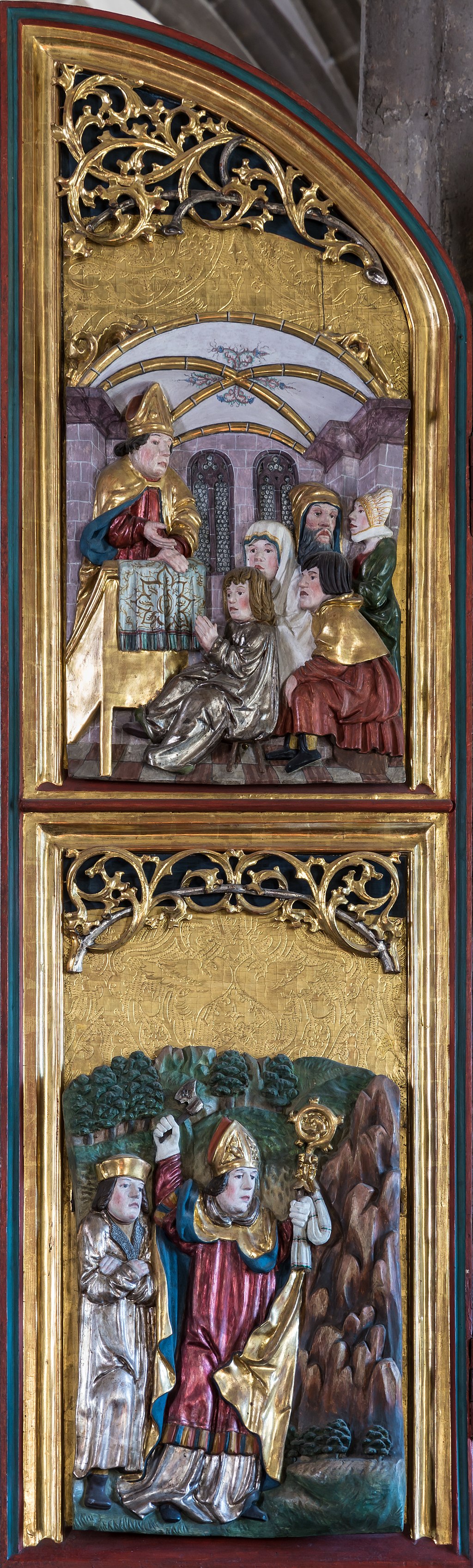
More artwork… https://www.christianiconography.info/Wikimedia%20Commons/wolfgangAltarpiece.html PIctures of an altarpiece in a church of Saint Wolfgang in Austria.
 Janey's blog
