Yesterday, August 28, was the Feast of Saint Augustine of Hippo. Lots of people wrote about him but what I loved was the many pictures gracing the articles. The picture where he catches his heart in his hand, and it has caught fire from the Holy Spirit made me laugh.

Saint Augustine, oil on canvas by Philippe de Champaigne, c. 1645–50; in the Los Angeles County Museum of Art. http://www.lacma.org
The National Gallery of Art in DC has several woodcuts with Saint Augustine, including the header for today, Saint Augustine Subdues Heresy with Lightning Bolts from His Pen Joseph Hartmann, 1747 – 1788.
NGA also has this gorgeous altarpiece which includes Saint Augustine with thirteen other saints, plus angels, and God the Father, and the Holy Spirit.

The Baptism of Christ. c. 1485/1500. The artist has no name except Master of the Saint Bartholomew Altar and painted in the late 1400’s. This link takes you to the NGA website where you can see the picture more clearly. https://www.nga.gov/artworks/46177-baptism-christ
Saint Augustine is shown near the top left of the saints. He’s holding his heart and Saint Agnes is next to him. Commentary on the painting suggests that no-one is sure who one or two of other the saints are. It’s easy to pick out Saint Christopher and Saint George. The saint on the right, who is giving up her queenly crown is harder, because there are several women like that. Saint Elizabeth of Portugal and Saint Hedwig are two of them. The girl with a knife in her neck is Saint Lucy. I thought that the saint with the red hat was quite distinctive but the National Gallery suggested Saint Jerome, with a question mark.
The red hat, I discovered, is called a galero and it is worn by cardinals, even today, although not when Saint Jerome was alive. Both Saint Bonaventure and Saint Peter Damian are occasionally shown with the red hat, but Saint Bonaventure should also have the brown robe of a Franciscan. I found several pictures of Saint Peter Damian and the hat, but it is always shown on the ground next to him, never on his head. On the other hand, I found this Rubens picture of Saint Jerome. So I’ll go with anachronistic Saint Jerome. It was a useful reminder to me that they were contemporaries, correspondents, and occasional combatants.
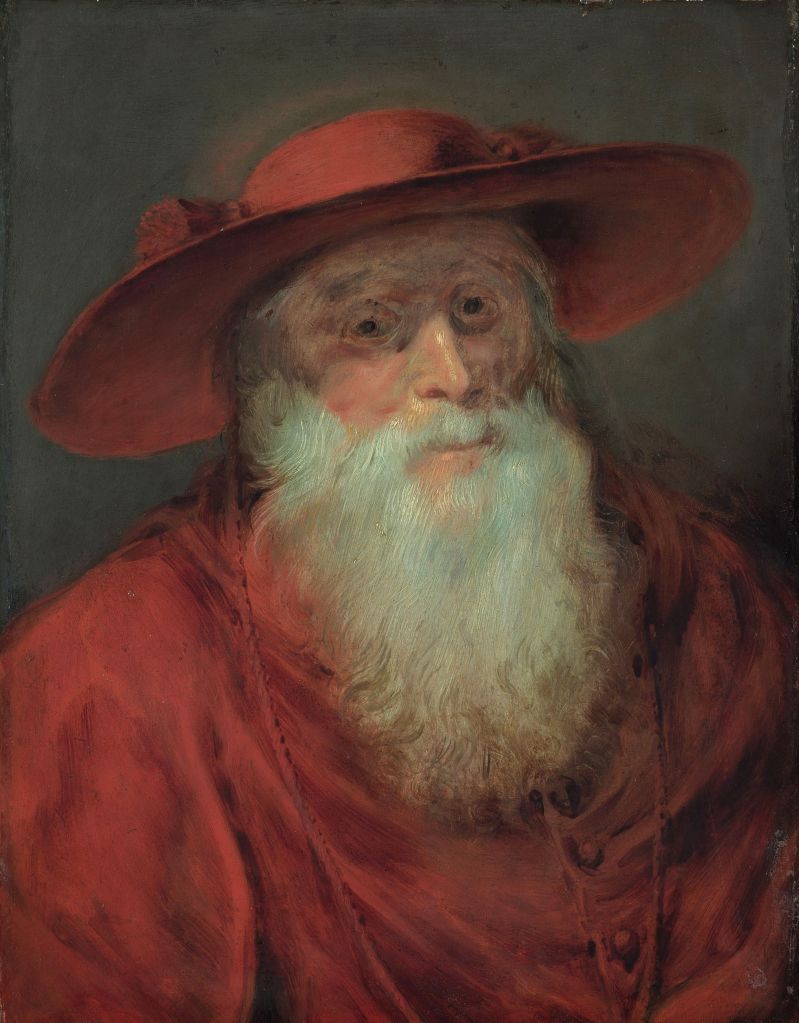
St. Jerome in the Vestments of a Cardinal
Artist:
Peter Paul Rubens (1577 Siegen – 1640 Antwerpen) DNBarrow_outward
Time:
1625/30
An article from the Italian Arts Society starts with a picture of Saint Augustine’s tomb in Pavia in Italy.
Why Pavia? Saint Augustine was originally buried in Hippo in North Africa, where he was bishop when he died. It became intensely unsafe for Christians as the Vandals moved in, so his body was moved to Sardinia, an island in the Mediterranean. This island was eventually threatened by the Saracens so Augustine’s body was moved to Pavia 720 A.D. The incredibly elaborate tomb pictured above was built in 1362. The article has more lovely pictures including one of Saint Augustine and his mother, Saint Monica by Ary Scheffer. See here for a better view of that particular bit of art. https://www.nationalgallery.org.uk/paintings/ary-scheffer-saints-augustine-and-monica It is incredibly serene.
A brief summary of the life of Saint Augustine if you need it after all the art. https://www.catholicnewsagency.com/saint/st-augustine-573
 Janey's blog