I took a look at some of the March saints, especially ones for March 4. Saint Casimir of Poland, listed as a patron of Poland turned up first. He lived in the 1400’s, and was a grandson of King Jagiello who married one of my favorites, Saint Jadwig. Saint Casimir was not Jadwig’s granddaughter.
Jadwig’s only child was a girl who died at the same time as her mother in 1399, a few days after Jadwig gave birth. Jagiello remarried, three times, and had a child named Casimir IV Jagiellon or alternatively, Casimir Andrew Jagiellon with his fourth wife, Sophia of Halshany, who was fifty years younger than Jagiello. How that child ended up being the king of Poland was too much for me to follow, but he had a reputation as a powerful warrior and king. He finished off wars with the Teutonic knights that his father had pursued for Poland years earlier.
King Casimir Andrew had thirteen children, without getting married more than once. His wife, Elizabeth of Austria*, was related to very important people all over Europe, and Casimir Andrew’s children were kings of Bohemia and Hungary, or married to the nobility of Bavaria, or Brandenburg, or Pomerania, or Saxony. One son was an archbishop and three of the sons were kings of Poland, one after the other. (It was a tumultuous time to be a ruler in Central Europe.)
And then there was Saint Casimir, who I think was the third child out of the thirteen. From an article of the Catholic News Agency…
“The young prince had a distaste for the luxury of courtly life, and instead chose the way of asceticism and devotion. He wore plain clothes with a hair shirt beneath them, slept frequently on the ground, and would spend much of the night in prayer and meditation on the suffering and death of Christ.”
https://www.catholicnewsagency.com/saint/st-casimir-of-poland
Saint Casimir was well known in his own time for his embrace of poverty and was canonized 1522 by Pope Adrian IV. And then there’s this picture of him. With three hands.
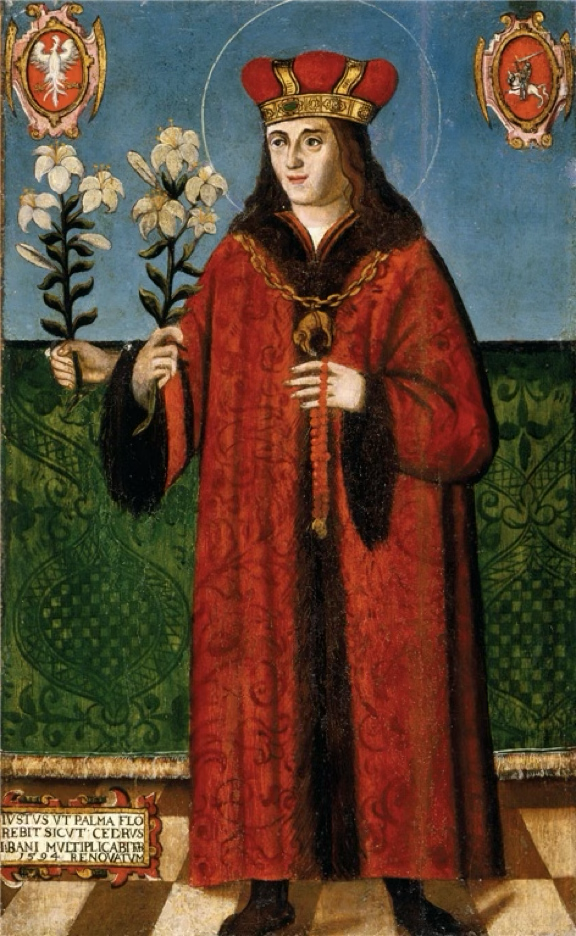
The three-handed painting came about either because the painter was representing Saint Casimir’s generosity, or because, having painted one hand, the artist changed his mind and painted another, but the first hand (miraculously) wouldn’t stay covered. This article explains the painting and includes a description of Saint Casimir’s brief life. https://www.ncregister.com/blog/st-casimir-saints-and-art
This was an entertaining rabbit hole from start to finish!
 Janey's blog