Last Monday I was sitting at the kitchen table writing away, when I happened to look up and saw the top of a tree moving at high speed from the left of the window to the right. For a shocked moment I wondered if I was seeing a tree fall. As the tree flipped to the left again I realized I was seeing a fairly tall and thin young sapling being blown back and forth in a high wind. In fact, there was a lot of ‘activity’ high up in the woods behind my house. The Beaufort wind scale** says you are looking at gusts up to thirty-five miles/hour when tree tops blow around like that. https://www.rmets.org/metmatters/beaufort-wind-scale
I saw erratic wind gusts for the rest of the day along with odd cloud formations and brilliant blue sky. Many years ago when I taught an Atmosphere unit I learned about the Norwegian meteorologist, Vilhelm Bjerknes (1862-1951). He gave the name ‘front’ to the intersection of weather systems, likening that intersection specifically to a battle zone. While I was out on Monday I saw this phenomenon in the sky.

Yup. This is a front. You can see the new weather system rolling in from the NW. It isn’t raining under those clouds.
Another picture taken looking towards the southeast.
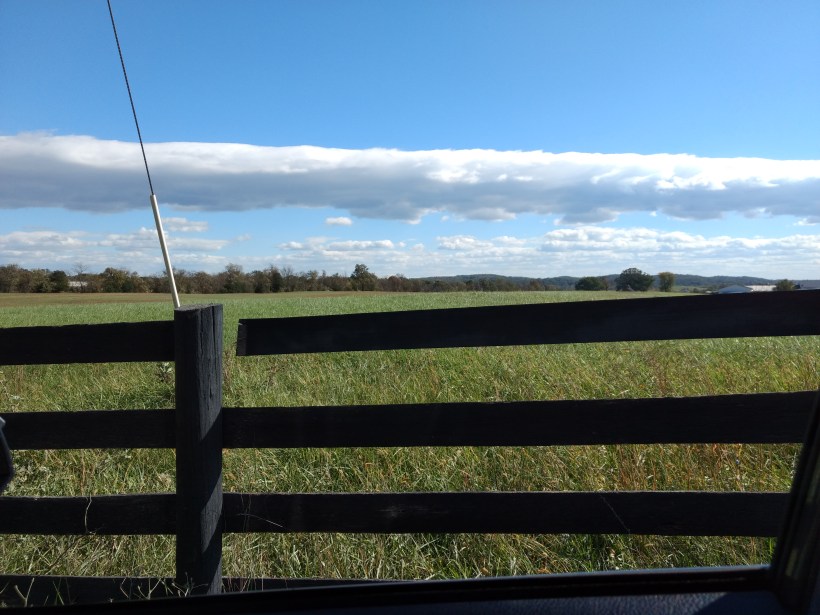
You can see in this picture that a bit of the cloud front has been torn off and there’s gorgeous blue sky between the clouds to the NW and SE. The blue sky on Monday, above all the winds and between the clouds was spectacular. Checkout the header for another example.
Speaking of studying clouds, a Catholic scientist, of whom I only recently became aware, is Father Benito Viñes, S.J. He is known as Padre Huracan in Cuba, and in his Jesuit community. He taught at Belen college in Havana in the 1800’s and studied the upper atmosphere. He was the first person to predict hurricanes that would strike Cuba, through observations of the clouds that preceded them. He was able to suggest how bad some of them would be, depending on the wind direction.
New Advent has this to say, though you can’t find it under Viñes. He appears in the article on Havana. (Remember that this encyclopedia was written around 1908.)
…to the Royal College of Belén, … belongs, moreover, the glory of its observatory which began its existence in 1857 under the direction of the Rev. A Cabré, S.J. … [in] 1870, the religious with whose name … the glory of Belén will ever be inseparably linked, took charge of the observatory — Father Benito Viñes, S.J., a man of a patient and investigative turn of mind, whose observation not the minutest details escaped, while he formulated principles and deduced general laws. (I love this descriptions of a scientist!)
For twenty-three years (1870-93) he persevered in his charge, and … augmented the apparatus of observation, acquiring exact modern instruments (1882), … gained honourable distinction … at … [World] Exhibitions. His predictions were regarded in Cuba as oracles, and ship-captains looked upon him as their official adviser. In 1877 he published his work on West Indian hurricanes which … complemented by his posthumous “Investigaciones”, constitutes the most complete and original work on the subject in existence.
An article from the Archdiocese of Miami in 2013 does a great job of Father Viñes and his studies. https://www.miamiarch.org/CatholicDiocese.php?op=Article_131017125417303_E The article gives specific examples of the clouds that “Father Hurricane” was watching.
… when he saw black rain clouds, called nimbus, coming from the east, for example, the hurricane was south. He put all this information into a device called an inner phase cyclonoscope with which it is possible to locate exactly where a hurricane is …
**The Beaufort scale was invented, by the way, so that an ordinary observer could guess at wind strength just by careful observation of phenomena. On ships it was about the way a flag moved. On land, where there might not be a flag, the motion of trees and twigs is more readily observable.
 Janey's blog