I’ve developed some fellow feeling lately with those guys who look at cars and know what model and make they are. Maybe the year. Pontiac Thunderbird, 1972. Mazda Miata. Ford Model A, 1937. DeLorean. Not that I know anything about cars. **
But for the last few months when I go to church and the priest comes out to say Mass, my automatic thought is, “Oh, he’s wearing a chasuble with a Borromeo cut using DaVinci fabric.” Or Roman cut. There’s a million versions of “Roman” which I can’t distinguish, yet. Fiddleback. Spanish. Italian. French. Then there’s Gothic cut, which is what has been the norm for the last thirty years. There’s also semi-Gothic, and I’m confused about what semi-Gothic actually is. I can’t personally tell you the difference between the Spanish and Italian designs for chasubles, but I know you can find pictures of them online, and it’s all about the way the front is cut.
I haven’t been able to find anything so clear-cut (haha) about semi-Gothic. I think it is all about how far down the arm the outer vestment (the chasuble) reaches. A Gothic chasuble will reach from wrist to wrist. There’s a lot of fabric there so it has to be light and a bit flowing. The ‘Roman’ or Fiddleback chasubles are cut high on the shoulder, and the front panel often curves outward towards the bottom. This shape means that the fabric must be very stiff and/or have a lot of layers of interfacing, or it will droop in very unattractive ways. This is the exact opposite of the way fabric needs to behave for a Gothic chasuble.
I believed the diagram below came from the blog, The New Liturgical Movement, (https://www.newliturgicalmovement.org/) but I can’t find it there, so maybe the picture is from a site called Altarworthy, which my computer currently won’t let me access.
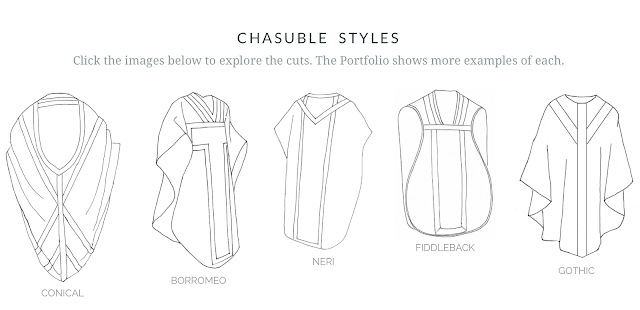
And this is where the semi-Gothic or Borromean or Saint Philip Neri cut makes its appearance. A close examination of the diagram above shows that we are looking at the front of a Borromeo and the back of a Neri. That’s … not helpful to me. What distinguishes both of them is that the garment ends partway down the arm. Is the finished garment supposed to be stiff or fluid? I’ve been going to Mass for more than half a century and never paid attention to a lot of these details. Now I need to know because … it’s not totally easy to find a pattern for this in-between vestment. I’ve ended up trying to draft my own pattern. And it’s made me super conscious of what is being worn and how it was put together.
RABBIT HOLE: Want to know what the words Gloria, NuGregory, Musical Angels, Normandy, Agnus Dei, Regal, and Chi Rho have in common? They are fabric patterns on the https://lalameinc.com/ website for liturgical brocade. The M. Perkins website has names like Winchester, Lichfield, Glastonbury, Saint Aiden’s, Cloister, and Ely. Eye candy if you are interested. https://www.mperkins.co.uk/fabrics
RABBIT HOLE: That conical garment is made by taking a semicircle of fabric and bring it together along the straight line. Sew that straight line most of the way up, leaving the top part for the head to emerge. Simple. Extremely uncomfortable looking. Elizabeth Morgan has a discussion of this kind of garment here. https://www.churchlinens.com/vestments/ Fortunately the conical chasuble discussion is right at the beginning of this section. She is exhaustive, whatever she writes about.
**Last time I called AAA for a flat tire I told them the wrong color for my car, and had to call back and say it was gold not silver. And no, I wasn’t messing around with someone else’s car. Fortunately, I had given them the right license number … because I had gone out and looked … and I still told them the wrong color.
 Janey's blog