My beautiful parish church has marble statues from a church in California, that was damaged in an earthquake. (They were free, except we had to pay transport. So, not free. Very expensive, in fact.) There are stained glass windows from two different churches, torn down in Pennsylvania, and the Stations of the Cross are molds from Saint Thomas the Apostle Church, in Harlem, New York City. The church itself was falling apart and my pastor wanted to save the Stations. Some historical society and local citizens got involved. In return for fixing the Stations, Our Lady of Hope was allowed to make casts of the originals. The originals went back into the church in Harlem and we have replicas done in fiberglass.
The Stations are not quite life-size, but they are huge and full of detail. Pontius Pilate washes his hands and ‘water’ pours out of the pitcher. A whip appears out of the frame. There are dice in Station 10 and a skull below the crucifix in Station 12. Simon of Cyrene has a sickle on his belt and wheat at his feet.
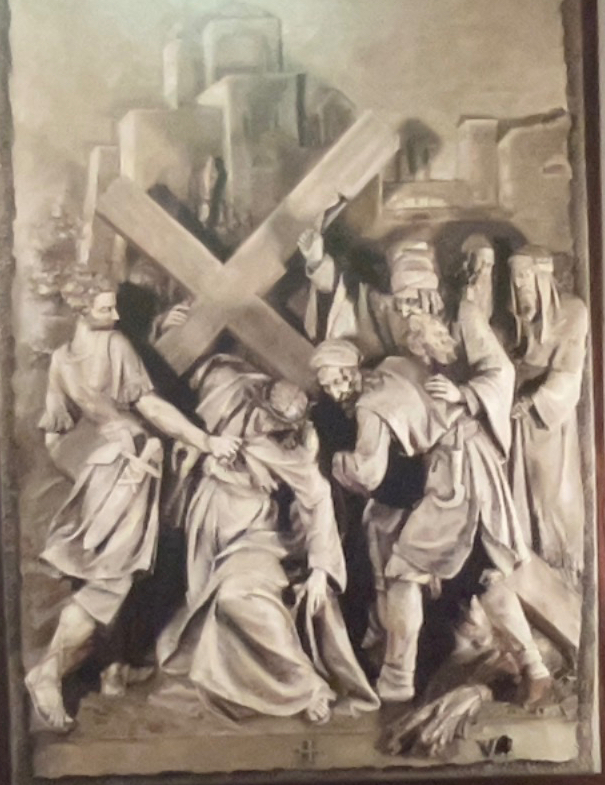
These pictures come from a book put out by the OLOH parish, A Labor of Love by Father Saunders. My copies are unfortunately blurred. But if you look closely you can see the sickle hanging from Simon’s belt and the wheat at his feet.
In Station 4 when Jesus meets his mother someone is carrying a ladder in the background. It shows up again in Station 13 when Jesus is being taken down from the cross.
A sword also reaches out in Station 7. Saint John shows up in Stations 4, 12, 13, and 14, as expected. He is recognizably the same person each time so when he shows up again in Station 7, (Jesus falls the 2nd time), it is obviously him, and a bit surprising. He is helping with the cross, a detail that came straight out of the artist’s imagination.
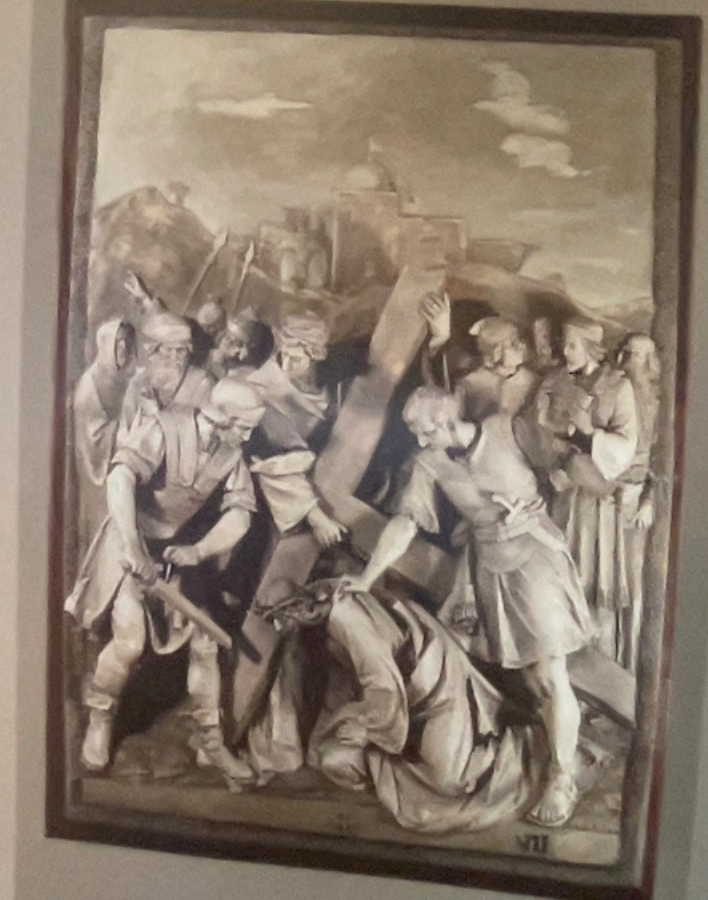
Here you can see Saint John with both hands on the cross. The soldier on the left has a sword that reaches right out of the Station towards the viewer.
I spent a lot of time looking at details of these Stations in order to write a sort of scavenger hunt for my students at OLOH many years ago. In Station 9 when Jesus is stripped of his garments there is a character who is not dressed as a Roman or as a first century Israelite. Here’s a picture of the station from a picture in a book.

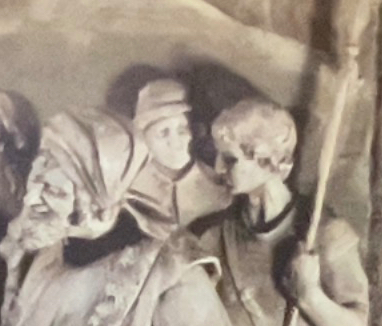
This is a tiny part of Station 9, Jesus falls the third time. The mystery person is the middle figure next to the lance holder. The headgear and shoulder capes are NOT Roman or Israelite.
I have wondered for years who this person is, and no-one seems to know. I began to wonder whether this was a ‘sacred conversation,’ that is, a picture that crosses time. There are famous paintings with Saint Dominic and Saint Catherine at the Birth of Jesus. Alternatively, a painter uses himself as a model for the apostles or other characters or sticks his patrons in the artwork.
These Stations were created in 1889, so I looked up Saint Katharine Drexel, though it’s a little early for her. She is shown wearing the old-style wimple with a band across her forehead. So, no.
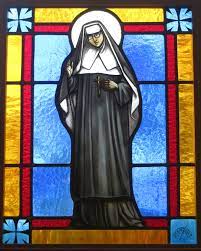
Saint Katharine Drexel from Saint Stephen the Martyr Catholic Church in Chesapeake Virginia.
Nheyob, CC BY-SA 4.0 https://creativecommons.org/licenses/by-sa/4.0, via Wikimedia Commons
How about Saint Frances Xavier Cabrini? She is usually shown with her hair, parted in front and then covered in the back. Not the Station image.

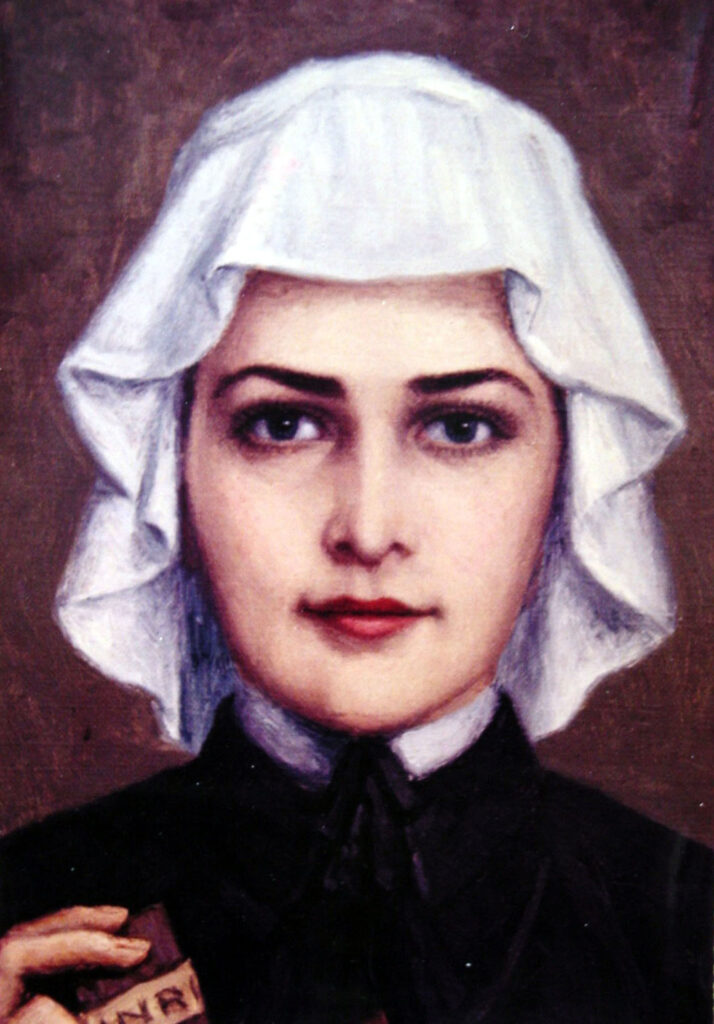
On a whim I checked out Saint Elizabeth Ann Seton. My internal memory of her images, always shows a profile, and in fact most pictures are like that. BUT, she is famous for a bonnet with a bit of a wavy edge and for a garment with shoulder capes. When I finally found a full face image, I thought that’s it.

This picture was taken from below the Station, that is in the position you would normally view it. The wavy bonnet is much more visible, along with shoulder capes, which are definitely a feature of Saint Elizabeth Ann Seton’s outfit.
Quite a surprise!
 Janey's blog