Last weekend I drove to West Virginia to visit an artist named Bridget, who might do a cover for my book. She is also a shepherdess with a large flock. She has sheep of several different breeds and I was fascinated to see that even from 30 feet away some differences were obvious.
For example, some sheep have fleece that is like a giant puffball all around them. Others have fleece that hangs down in defined curls. I’ve seen those curls washed and supposedly ready to be spun, but never actually spun them myself.
Bridge also has a fiber mill. In it she first washes fleece. There’s an intermediate ‘picking’ process that I didn’t understand. Then she cards or combs the fleece, mechanically. The carder has rows of teeth that look like big nails; fleece is dragged past those teeth, while resting on a screen. The fibers, a bit messed up from being washed and picked, are straightened and realigned into an incredibly long and fat sausage of fiber, called roving.
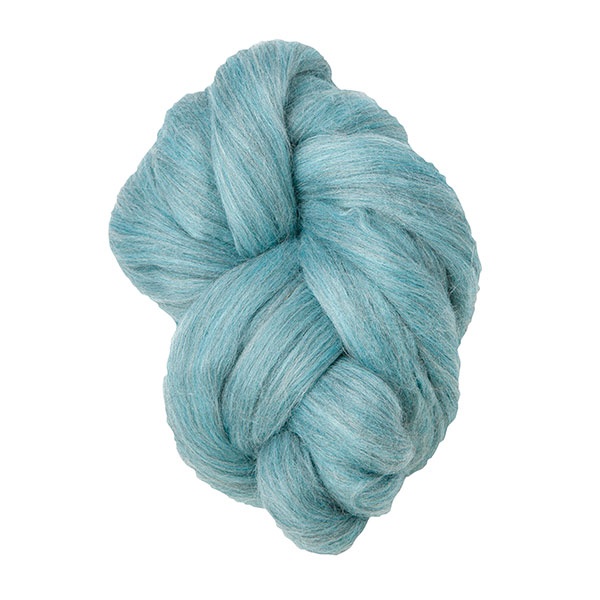
This is roving that’s dyed. You can see how parallel the fibers are.
I spin from roving. So does Bridget’s automatic spinning machine. It was mesmerizing to watch. Wool fiber sticks to itself a bit. When fiber is pulled and twisted that ‘sticky’ factor causes more fiber to attach itself to that which is being pulled. If you do it evenly it’s called spinning. Otherwise it’s called a big lumpy mess.
James Hargreaves invented the device called a ‘spinning Jenny’ in the 1700’s. It produced up to eight threads at a time with one spinner cranking a wheel. The original tradeoff was that the thread spun on a Jenny was of very poor quality. It didn’t have a lot of strength and could only be used as weft in a loom. There’s no tension on a weft so the strength of the material was not important. Eventually, with the use of more machines sturdy thread could be spun.
Bridget’s machine could do four threads at once or ply two sets of two together at the same time. The thread is ‘artistically’ imperfect. The only way to prevent the occasional thick and thin aspect would be to have absolute perfect roving, but her customers actually prefer the rustic look so she’s not worrying.
Several West Virginia artists, or possibly artisans, including Bridget joined together to arrange a studio tour. Among them were were two basket makers, a paper cutting artist, a guy with a lathe and another with a forge. BUT you had to drive for miles between the artists. So I only saw pictures from the others. I can plan for next year.
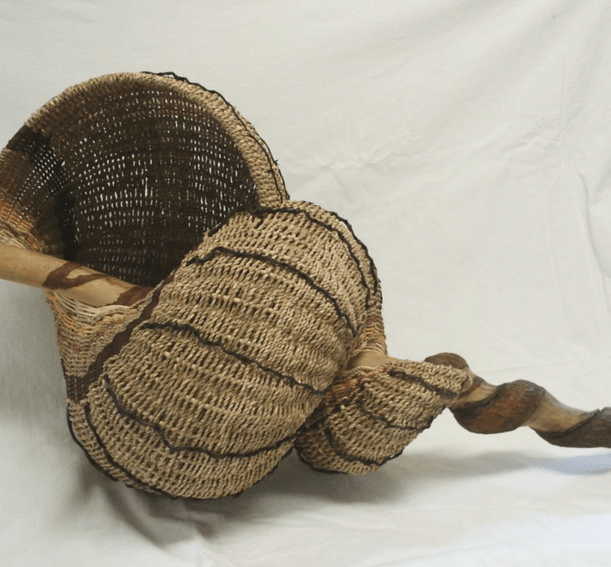
Meantime, this is not going to substitute for a Peterboro basket any time soon but it is lovely to look at.
Fun pictures of paper cutting from another artist at this URL. https://www.lizpaperarts.com/papercutting

A wooden bowl made on someone’s lathe.
THEN — When I went to read the blog of the Studio Tour, I discovered that somewhere near Harper’s Ferry there’s a house that was brought over from China and reassembled in the hills. The Tibetan Catholic farmer who built it, was being relocated, because a dam was going to drown his home. The website is annoying … https://www.chinafolkhouse.org/our-history

but here’s a lovely picture of the upper story.
If you want to see Bridget’s art you’ll have to wait till I put up a picture of my book cover.
 Janey's blog
What beautiful things you saw! I love the artists’ basket and bowl, and the Tibetan house will puzzle future scholars. Is Lovely.
LikeLike