I came to Santa Fe to see the eclipse on Saturday. My lovely hostess and I had a conversation about eclipses we and others have seen. She was worried that after the long journey there would be clouds.
We have a story of my father saying, “Hell’s Bells. I forgot my passport.” He said it on the morning he left for San Francisco on his way to China, for the 1948 eclipse that could be seen there. I mention San Francisco because the State Department managed to get him a passport at that city, so he could keep going.
In the end, he didn’t see the eclipse because it was cloudy.
Mary Orr Evershed, lover of Dante, was also an eclipse chaser and saw maybe half of the ones she went out to view. The efforts that went into one expedition in the far north included sled dogs, and such, but that is also one where the sky was not clear.
As it happened, it was so clear here in Santa Fe, and the sun was so bright in the morning, that you could hardly look east.
I had eclipse viewers, and they worked perfectly, making the sun look like a slightly yellower moon, and protecting our eyes. One of my former students is at Saint Johns College here for the fall semester. His mother heard that I was going to Santa Fe and gave me his contact information. He came and watched with us; at totality he turned on Ring of Fire (Johnny Cash) and we sang a bit with it. Very funny.
An annular eclipse happens when the moon is just slightly further away from the earth than ‘normal.’ When I was researching annular eclipses, I read about an eclipse that was annular at either end of the path of viewing but total in the middle. Crazy. The sun appears as a ring all the way around the moon at totality. It’s about 10% of normal. With an annular eclipse you don’t see the atmosphere writhe like a snake, and you don’t see a corona, and it hardly gets dark. In fact it’s a good question how people ever knew that something was happening. The dogs here did bark briefly…
The advice people give nowadays about seeing the progress of an eclipse is to make a pinhole in … something … and hold it up in front of a piece of white paper or a white wall. The light passing through the pinhole makes a little light dot on the wall. And if you do this during the eclipse that little round light dot will change shape, showing the growing crescent shape of the sun in the lighted crescent on the wall.
I discovered long ago that you don’t need a piece of paper. I was dancing down Thornapple, at some young age, when I saw that the maple leaf shadows at my feet had little lighted crescents all through them. I don’t remember knowing ahead of time that there was a partial eclipse that day. I discovered that you can lace your fingers and get the same effect. A small enough hole in anything works. And “small enough” is relative to how far away the shadow is.
Back in Santa Fe, we stood on a balcony, and our shadows fell on the ground twenty feet away. You could get great crescents by bending your arms, or touching your head, or acting like a monkey. Because the sun was still visible on each side of the moon, the shadows became very diffuse and doubled. The effect was like two spotlights on the same object. Hands looked spooky, with eight or nine fingers each and the whole body outline was insubstantial. We had a lot of fun playing with this effect, but I was never able to get a good picture.
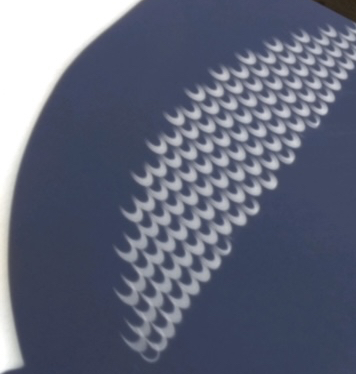
We also had a colander tipped up and the pictures from that are here. The first picture is at 10:31…
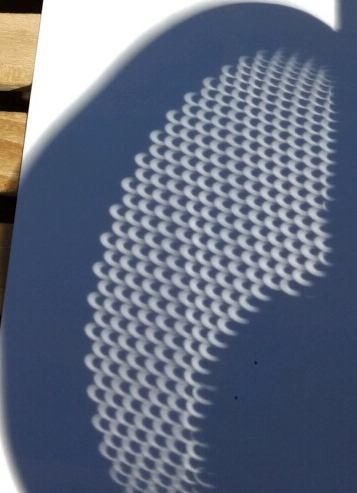
… and the second at 10:42. You can see the moon coming in from the upper left and leaving from the lower right.
The sun was in the east and at 10 a.m. it was fairly high in the sky. The moon covered it, starting from the top so that initially the crescents were pointing up and at the end the crescents pointed down.
One fascinating detail here is, that we think of the moon as moving from east to west. That’s what we see all night long if we watch it, because we are seeing the turning of the earth. But the moon is actually moving west to east, which is why, from one night to the next, it changes position when viewed at the same time. New moons occur near the sunset, and full moons, fourteen days later, are opposite the sunset in the eastern sky.
In this, or any eclipse, you can see the moon moving west to east, blotting out the sun then revealing it again.
We sent my former student home with a pumpkin pie, after discussing Milton’s Paradise Lost. Along with never reading Dante in my youth, I never read Paradise Lost, but my former student said he wanted my opinion. Totally flattered of course, I read as much as I could, and then confessed when I saw him, that I had only read half. He was gracious about it.
 Janey's blog