I wrote earlier about the driftless area in Iowa and Wisconsin. Drift is an older word for the stuff that glaciers move around, and then leave behind as they melt. I’m more familiar with ‘moraines’ and the hills they create. Seattle is an example. Those hills are steep but unstratified (unlayered) junk. The hills around Dubuque in Iowa are limestone layers, with fossils from the Devonian in them. You can see the layers in the bluffs that rise above the Mississippi flood plain.
However, the bluffs are steep. In the late 1800’s when the flood plain in Dubuque was the site of factories, and the bluffs were a much healthier place to live, a rich man built a steep little railway down from his house to the flood plain. It was meant to get him to and from his office, but his neighbors hitched a ride. The little railcars plunge straight down. When this man (whose name I can’t find) (unless it’s Fenelon) went broke, his neighbors banded together to keep his little railway running, because the prospect of climbing the bluffs on foot was horrifying.

We have stayed at a bed and breakfast, about six blocks north of the Fenelon Street Elevator. Outside the house there is a spiral staircase that you can descend to reach the next street down. Driving up is a matter of switchbacks and nerve.

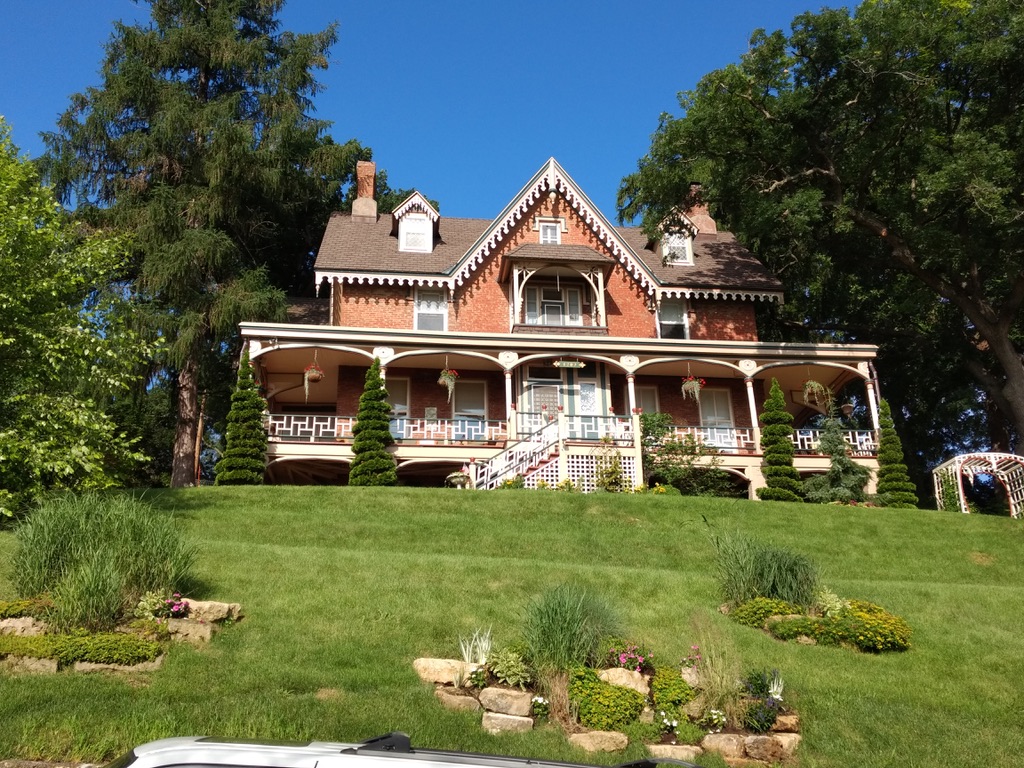
I took this picture standing on the sidewalk below the house looking up. There are four mansions in a row and they are utterly gorgeous inside. But they are built on steep land. The mansion to the left of this red house is the bed and breakfast where we stayed. At its back there is a little bridge leaving from a 3rd floor room, crossing a six foot gap and depositing you on a twenty foot staircase/ladder up to the street above these houses.
I’m providing a link below to a real estate listing for the red house (which will probably rot quickly). If you look at pictures 28 and 29 on the site and realize that they have been taken by someone at street level behind the house you might get some sense of the height of the bluff. Picture 3 is very deceptive, making everything look as if it is much less steep!
https://www.realtor.com/realestateandhomes-detail/1155-Grove-Ter_Dubuque_IA_52001_M89406-43832
Remember I said earlier, this are was NOT ground down by the glaciers, and as a result it could be mined for lead. I never looked up why the lead was there originally, but in other areas where glaciers passed, the layers have been ground together and homogenized, and the lead is no longer able to be separated economically.
One result of the availability of lead was an effort to produce lead shot for round bullets, just before the Civil War. Liquid that is dropped from a height will break up into round balls. Surface tension drives this formation into spheres and the height from which the liquid drops has to match its characteristics. Lead needs to be dropped from a great height, preferably through a sieve, to have time to become spherical. Someone in Dubuque built a shot tower for dropping lead from 120 feet up. The tower was in use for just a couple of years before it was bought by a rival shot producing firm, and closed. After a number of ups and downs it is now a tourist attraction near the water.
My current WIP is a book about a girl in Iowa so it is important for me to have some understanding of the different areas of the state. Since she is living in the southeast she’s on the edge of the driftless area. Almost everywhere in Iowa, but especially in eastern Iowa, beautiful churches were built and she’s definitely in that milieu. For my plot I needed an amazing old house so I’ve been paying attention to those that were built back then. They are … stunning, or ridiculously stunning. Not sure which.

Here’s the bed and breakfast above. Below is another of the houses along this ridge. They are called the Painted Ladies.
 Janey's blog
